On the Rise of Fascism
I am worried.
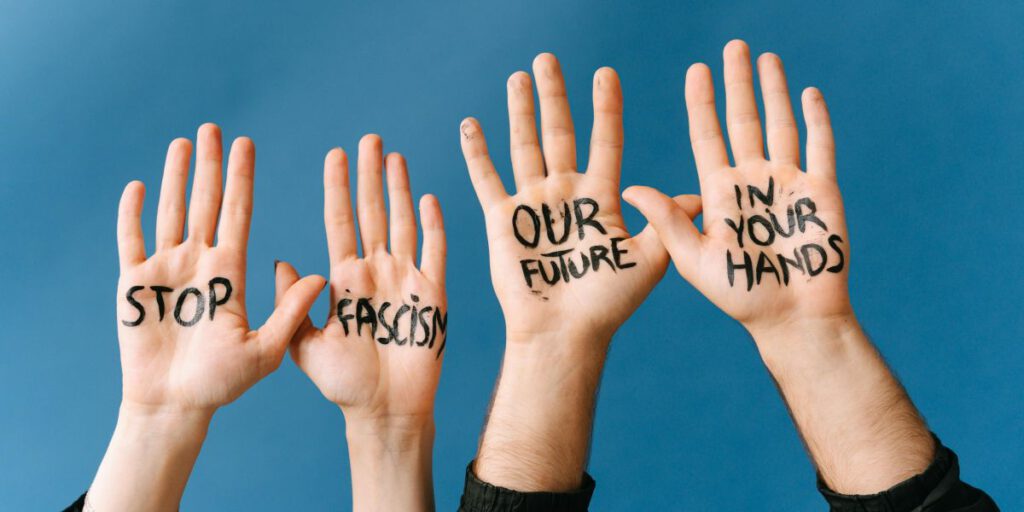
The last couple of years the development of nationalistic and authoritarian tendencies has been escalating.
It’s not only in the US. It’s also here in Sweden, and I believe it’s everywhere in the West. The social media climate is harsh, very polarised and divided between what the nationalistic conservatives want to call right vs left.
But, is it really a division between a political right and left? What I see is another division. I see a division between people striving for homogeneity, which is usually driven by fear and the feeling of safety within the known norms and way of life – and people who are more open to diversity.
Science shows that these two groups of people are mostly separated by having or not having the cognitive ability to understand complexity, and the emotional maturity to accept it and not feel threatened or stressed by it.
Liberals and “leftists” are more likely to have a more open mindset. Conservatives seek homogeneity, and have a hard time accepting differences.
And their solutions are starting to look a lot like fascism.
Let’s take a look at some aspects of fascism in comparison with humanism.
Fascism and humanism represent polar opposite worldviews regarding morality, empathy, and human value.
Humanism is a democratic, secular life stance that emphasizes the universal dignity of all humans and uses empathy and reason to improve welfare.
Fascism is an exclusionary, authoritarian ideology that prioritises the power of the state or a specific master race or group above individual human worth, relying on aggression and dehumanization of “others” (like minorities, immigrants, or political opponents) to justify their exclusion or destruction and to maintain control.
Humanist morality is based on the human experience, rather than externally imposed dogmas. It relies on reason and compassion to reduce suffering, arguing that actions are good if they promote human flourishing. Individual differences are welcome because all people are inherently different, and in order to flourish, people need to feel accepted.
Fascism treats morality as a practical instrument of power rather than a protection of human life, frequently glorifying violent approaches to conflicts (from the level of verbally attacking people with other opinions online, to gaining power and control through instances like ICE, or even war). Homogeneity and exclusion are the basic principles, and fascism demands that individuals prioritize the state, and state dogma, over their own personal thoughts and feelings.
Empathy is foundational to humanism, whereas fascism is defined by a distinct lack of empathy, often viewing it as a sign of weakness. If empathy is present it is often very selective, and only for people perceived as having the right values, race etc.
In essence, humanism views the human as the center of value, while fascism treats the individual as a expendable part of a greater, often destructive, collective machine.

This development makes me worried, all in itself, but it is also worrysome when we talk about schools. The type of school we promote is not producing the kind of people the right-wingers want for their controlled, homogeneous world.
Focusing on emotional and relational skills development, letting students learn democracy through being a part of it, and letting them learn to rely on their inner compass and take responsibility for their own learning, are not values they see as important.
Instead they want schools that prioritises strict discipline and high academic expectations. Like “No Excuses” schools, with key features including longer school days, teacher-led instruction, rigid behavior codes, and frequent testing.
But, even though those schools can create better short-term results – that is, making part of the students get higher grades – they also exclude and leave behind a lot of children. And having a rigid and maybe even punitive “pedagogical” philosophy will only boost the psychology that makes people become fascists.
Compliance. Compartmentalised learning. Competition…
It doesn’t promote personal development, democracy or life-long learning. Or:
Compassion. Co-creation. Courage. Curiosity…
I would argue that it has never been more important to do the exact opposite. Don’t go in the direction of authoritarian schools. Liberate learning, focus on personal development and maybe we can stop this frightening development.
Written by Sarah Rosendahl